Plainfield Epoxy Flooring provides warehouse floor coating for distribution, storage and industrial buildings in Plainfield, IL, using 20+ years of experience with slabs under heavy traffic, and we work in surrounding cities including Shorewood, Minooka, North Aurora, Warrenville and Lemont. A warehouse floor carries forklifts, pallet jacks, racking loads and constant movement, and the coating or treatment has to match that use without shutting the business down for long.
Most warehouse floor work along Plainfield’s commercial corridors is specified by the owner or tenant, and the right system depends on how each part of the building is used. Storage aisles, loading docks, battery charging areas, packaging lines and cold storage rooms can each call for a different approach on the same slab.
We start with the slab itself, testing moisture, mapping joints and cracks, and noting where traffic and spills concentrate. The proposal then names the products, the system build and the finished thickness for each area, so facility managers can check what was installed against what was quoted.
Warehouse Floors in Plainfield’s Industrial Corridors
Distribution Buildings Along I-55 and Route 59
Plainfield’s commercial and industrial floor work is concentrated along 143rd Street and the Route 59 and Route 30 corridors, where large warehouse and distribution buildings sit close to I-55. These buildings often have large new slabs that need densifying, joint filling and coatings in specific areas rather than one system across the whole floor.
Cold Storage Buildings
The area includes a 390,620-square-foot cold-storage building, and cold storage floors present special challenges. Low temperatures slow curing and affect bond, so coatings must be rated for cold service, and installation is often planned around cooling cycles or done before a space is brought down to temperature.
Tenant Turnover and Spec Changes
Warehouse tenants change, and a new tenant may need different floor markings, coatings in new process areas or repairs left by the previous user. We work from the new tenant’s specification, removing old markings, repairing damage and coating new zones as needed.
Systems for Forklifts, Racking and Spills
Densified and Polished Concrete
For large storage areas, a lithium silicate densifier can harden the slab surface, reduce dusting and make the floor easier to clean. Densifying and light polishing suits areas with moderate traffic and few spills, and it avoids a coating that might wear in forklift lanes.
Densified floors also reflect more light than raw concrete, which helps in tall racking aisles, and they are maintained with auto-scrubbers and neutral cleaners rather than recoating. When a densified area later needs chemical protection, a coating can still be added there after proper grinding.
Epoxy and Urethane Systems
In areas with chemical spills, heavy impact or sanitation needs, such as battery charging stations, packaging lines and maintenance shops, we install thicker epoxy or urethane systems. These are built to the specified thickness, often with quartz aggregate broadcast for texture and wear resistance.
Chemical and Battery Areas
Battery charging areas see acid spills, and maintenance areas see oils, fuels and solvents. We check the coating’s chemical resistance against the actual exposures in each zone, so the floor holds up to the conditions rather than failing in the first spill.
Loading docks deserve their own attention. Trucks and dock plates bring in water, road salt and grit from outside, and forklifts make tight turns at the dock edge, so we often use thicker, textured systems there than in the interior aisles.
Joints, Striping and Repairs
Semi-Rigid Polyurea Joint Filler
Control joints chip and widen under forklift wheels, creating bumps that damage loads and equipment. We clean out joints and fill them with a semi-rigid polyurea joint filler that supports wheels while allowing some movement, and we refill joints on young slabs that are still shrinking.
Aisle Striping and Safety Markings
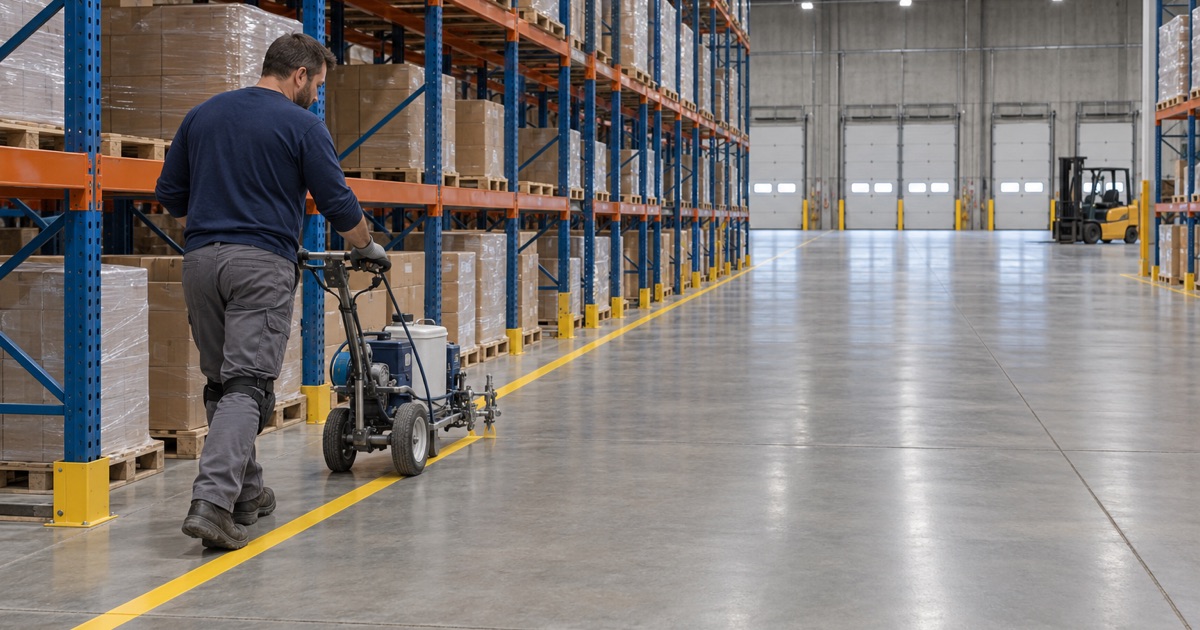
We lay out aisle lines, pedestrian walkways, staging areas and hazard markings based on the facility’s traffic plan. Markings applied into or over a coating system last longer than paint applied directly to bare concrete, which wears off quickly in busy aisles.
Colors usually follow the facility’s own safety program, with yellow aisle lines and other colors for walkways, storage, hazards and staging areas. We match the existing color scheme on a phased job so new and old sections of the floor read as one system.
Crack and Spall Repair
Cracks, spalls and broken joint edges are repaired before coating, and areas with failed concrete are identified for replacement. We tell owners plainly when a section needs replacement rather than coating over a failing slab.
Rack anchor holes left behind when a layout changes are another common repair. We fill old anchor holes and grind them flush so new coatings and markings sit flat, and we note where new anchors will go so the coating can be planned around them.
Prep, Moisture and Scheduling
Shot Blasting and Grinding
Large warehouse floors are usually prepared by shot blasting, with edges and areas around racking diamond ground. We never acid etch, and all prep equipment runs with vacuum dust collection so dust does not settle on inventory or equipment.
Moisture Testing Large Slabs
New warehouse slabs can hold construction moisture for a long time, and older ones may have no vapor retarder below them. We test with ASTM F1869 calcium chloride kits or ASTM F2170 relative humidity probes across the floor, adding a moisture-mitigation primer where readings call for it.
Phased Work Around Operations
We phase warehouse work by zone, often overnight or on weekends, so racking, inventory and forklift routes can be moved in sections. Inside the village, the code allows construction work between 7:00 a.m. and 7:30 p.m. Monday through Friday and until 5:30 p.m. on Saturday, so any Sunday shift is booked only after the advance permit it needs is in hand.
Registration, Insurance and VOC Limits
Illinois does not license flooring contractors at the state level, so we confirm village contractor registration, bond and insurance requirements before scheduling. Illinois also limits VOC content in floor coatings and industrial maintenance coatings, and that rule applies to the installer as well as the manufacturer.
- 20+ Years of Floor Coating Work
- Moisture Testing in Every Scope
- Free Written Estimates